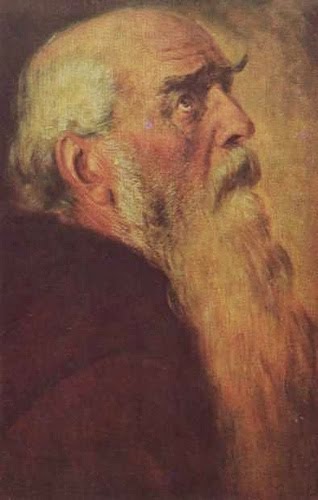
For today’s liturgical celebration of Saint Fidelis of Sigmaringen, at the Extraordinary Form of the Mass the Readings are a wonderful pick-me-up for those of us who get exhausted with the labors of trying to remain faithful to the Lord and His teachings while the ways of this age are constantly being thrust upon us, tempting us to give up the good fight, and use our energies to seek after temporal satisfaction.
“Then the just shall stand with great constancy against those who have afflicted them” (Wisdom 1:1). While it may seem that we are currently outnumbered, the word of God assures us of victory; and we know that this victory is not short-lived but eternal. Then there is a sort of reversal of roles: “These seeing it, shall be troubled with fear, and shall be amazed at the suddenness of the unexpected salvation” (ibid. verse 2). Imagine the shock when secularists will finally discover that Jesus really is the Way, the Truth and the Life.
Here’s what is perceived but then the reality is revealed: “We fools esteemed their life madness and their end without honor; behold how they are numbered among the children of God, and their lot is among the Saints” (ibid. verses 4 and 5).
While this might have a “TAKE THAT!” or revengeful tone, that is not the intent. As the faithful of the Lord, being men and women of prayer is who we are; and we are called to pray for the conversion of the culture. As if our prayer has been answered, verse three of this Reading from the Book of Wisdom does tell us that those who do not stand with the Lord will be “repenting and groaning for anguish of spirit.”
In the Gospel from Saint John, Jesus tells us that He is the True Vine (cf. 15:1). And He also offers very comforting words to His flock: The Father is the Husbandman or Cultivator and “everyone that bears fruit, He will purge it, that it may bring forth more fruit” (ibid. verse 2). Jesus continues, “Abide in Me: and I in you. As the branch cannot bear fruit itself, unless it abide in the vine, so neither can you, unless you abide in Me. I am the Vine, you are the branches; he that abides in Me and I in him, the same bears much fruit; for without Me you can do nothing."
These are wonderful words from our Savior and perhaps part of the anguish and stress of trying to remain faithful is that we don’t allow Jesus to be the General of our army. In our fallen state we tend to be gluttons for punishment. But as Jesus tells us: You can’t do this without Me.
Jesus also tells us that those who do not abide in Him shall wither (cf. verse 6). Certainly there are withering branches today and hearts need to be converted – and we can and should pray for that. Prayer is a most powerful weapon.
Sometimes it can be difficult to watch the great models go home to the Lord, like Saint John Paul II and Blessed Teresa of Calcutta. They were shining examples of fighting the good fight. And when they leave us, it can feel like we have lost the coaches of the team or that we’re suddenly orphaned, making the battle seem even more difficult. But the Lord provides and will always give us other prayer warriors to steer the ship.
Mother Teresa said, “I do not pray for success, I ask for faithfulness.” On this feast day of Saint Fidelis of Sigmaringen, how appropriate that Fidelis means Faithful which we are called to be, as this great saint of seraphic ardor was all the way to martyrdom.
FELIX CÆLI PORTA are words found in the Marian hymn AVE MARIS STELLA which is chanted/sung at Vespers of Our Lady.
Showing posts with label Franciscans. Show all posts
Friday, April 24, 2015
Monday, April 20, 2015
An Adoring Silence
Saint Konrad of Parzham, a Capuchin Franciscan, was born at Parzham, Bavaria, Germany. He wrote down a plan for his life which came under eleven different headings. Two of those headings were:
~ I will observe silence exactly and perpetually as far as is possible. I will be very sparse in speech, and this in order to avoid many faults and that I may be able to converse with God so much the better.
~ I will always strive to have a truly intense devotion to the Blessed Virgin Mary, and will truly strive to imitate her virtues.
One might hypothesize that the first resolution would be impossible without the second. Saint Konrad also offered to God very profound words while making a Spiritual Communion:
"I have come to spend a few moments with You, O Jesus, and in spirit I prostrate myself in the dust before Your Holy Tabernacle to adore You, my Lord and God, in deepest humility. Once more a day has come to its close, dear Jesus, another day which brings me nearer to the grave and my beloved heavenly home. Once more, O Jesus, my heart longs for You, the true Bread of Life, which contains all sweetness and relish. O my Jesus, mercifully grant me pardon for the faults and ingratitutde of this day, and come to me to refresh my poor heart which longs for You. As the heart pants for the waters, as the parched earth longs for the dew of heaven, even so does my poor heart long for You, Fount of Life. I love You, O Jesus, I hope in You, I love You, and out of love for You I regret sincerely all my sins. May Your peace and Your benediction be mine now and always and for all eternity. Amen."
Spiritual Communions, adoration of the Divine Indwelling, many saints made them every hour on the hour. In the Apostolic Letter,Orientale Lumen, Saint John Paul II wrote that "the more man grows in the knowledge of God, the more he perceives him as an inaccessible Mystery, Whose essence cannot be grasped." He continued by expressing that "one draws close to this Presence. . . by letting oneself be taught an adoring silence." And we can learn this adoring silence "through the prayerful assimilation of Scripture and the liturgy." And of this adoring silence the Holy Father wrote: "We must confess that we all have need of this silence, filled with the Presence of Him Who is adored. . . that we may never forget that seeing God means coming down the mountain with a face so radiant that we are obliged to cover it with a veil (cf. Exodus 34:33). All. . . need to learn a silence that allows the Other to speak when and how He wishes, and allows us to understand His words."
Saint Elizabeth of Trinity taught that a soul’s degree of glory in heaven would depend on the degree of Union with the Divine Indwelling, at the time of death. Is there anyone who ever walked on planet earth that had more intimacy with the Indwelling of the Most Holy Trinity than our Blessed Mother? There’s a story of a series of messages from our Blessed Lady to Sister
Mildred Mary Ephrem Neuzil of the Sisters of the Precious Blood in Dayton, Ohio. In one of the messages, the Mother of God spoke saying: "I am Our Lady of the Divine Indwelling, handmaid of Him Who dwells within." This September will mark the 54th anniversary of our Lady’s first alleged appearance to Sister Mildred. These messages and apparitions have not reached full official canonical approval as yet and are awaiting the final stage which is a formal written statement from the bishop of the diocese of Toledo, Ohio.
Cardinal Joseph Ratzinger, now Pope Emeritus Benedict XVI, in agreement with Saint John Paul’s assessment that we can learn silence from the liturgy, and which may also explain His Holiness’ call to restore a sense of the sacred in liturgy, wrote in his book, The Spirit of the Liturgy: "We are realizing more and more clearly that silence is part of the liturgy. We respond, by singing and praying, to the God Who addresses us, but the greater mystery, surpassing all words, summons us to silence. It must, of course, be a silence with content, not just the absence of speech and action. We should expect the liturgy to give us a positive stillness that will restore us. Such stillness will not be just a pause, in which a thousand thoughts and desires assault us, but a time of recollection, giving us an inward peace, allowing us to draw breath and rediscover the one thing necessary, which we have forgotten. That is why silence cannot be simply made, organized as if it were one activity among many. It is no accident that on all sides people are seeking techniques of meditation, a spirituality for emptying the mind. One of man’s deepest needs is making its presence felt, a need that is manifestly not being met in our present form of the liturgy. For silence to be fruitful, as we have already said, it must not be just a pause in the action of the liturgy. No, it must be an integral part of the liturgical event."
May we all discover that adoring silence!
~ I will observe silence exactly and perpetually as far as is possible. I will be very sparse in speech, and this in order to avoid many faults and that I may be able to converse with God so much the better.
~ I will always strive to have a truly intense devotion to the Blessed Virgin Mary, and will truly strive to imitate her virtues.
One might hypothesize that the first resolution would be impossible without the second. Saint Konrad also offered to God very profound words while making a Spiritual Communion:
"I have come to spend a few moments with You, O Jesus, and in spirit I prostrate myself in the dust before Your Holy Tabernacle to adore You, my Lord and God, in deepest humility. Once more a day has come to its close, dear Jesus, another day which brings me nearer to the grave and my beloved heavenly home. Once more, O Jesus, my heart longs for You, the true Bread of Life, which contains all sweetness and relish. O my Jesus, mercifully grant me pardon for the faults and ingratitutde of this day, and come to me to refresh my poor heart which longs for You. As the heart pants for the waters, as the parched earth longs for the dew of heaven, even so does my poor heart long for You, Fount of Life. I love You, O Jesus, I hope in You, I love You, and out of love for You I regret sincerely all my sins. May Your peace and Your benediction be mine now and always and for all eternity. Amen."
Spiritual Communions, adoration of the Divine Indwelling, many saints made them every hour on the hour. In the Apostolic Letter,Orientale Lumen, Saint John Paul II wrote that "the more man grows in the knowledge of God, the more he perceives him as an inaccessible Mystery, Whose essence cannot be grasped." He continued by expressing that "one draws close to this Presence. . . by letting oneself be taught an adoring silence." And we can learn this adoring silence "through the prayerful assimilation of Scripture and the liturgy." And of this adoring silence the Holy Father wrote: "We must confess that we all have need of this silence, filled with the Presence of Him Who is adored. . . that we may never forget that seeing God means coming down the mountain with a face so radiant that we are obliged to cover it with a veil (cf. Exodus 34:33). All. . . need to learn a silence that allows the Other to speak when and how He wishes, and allows us to understand His words."
Saint Elizabeth of Trinity taught that a soul’s degree of glory in heaven would depend on the degree of Union with the Divine Indwelling, at the time of death. Is there anyone who ever walked on planet earth that had more intimacy with the Indwelling of the Most Holy Trinity than our Blessed Mother? There’s a story of a series of messages from our Blessed Lady to Sister
Mildred Mary Ephrem Neuzil of the Sisters of the Precious Blood in Dayton, Ohio. In one of the messages, the Mother of God spoke saying: "I am Our Lady of the Divine Indwelling, handmaid of Him Who dwells within." This September will mark the 54th anniversary of our Lady’s first alleged appearance to Sister Mildred. These messages and apparitions have not reached full official canonical approval as yet and are awaiting the final stage which is a formal written statement from the bishop of the diocese of Toledo, Ohio.Cardinal Joseph Ratzinger, now Pope Emeritus Benedict XVI, in agreement with Saint John Paul’s assessment that we can learn silence from the liturgy, and which may also explain His Holiness’ call to restore a sense of the sacred in liturgy, wrote in his book, The Spirit of the Liturgy: "We are realizing more and more clearly that silence is part of the liturgy. We respond, by singing and praying, to the God Who addresses us, but the greater mystery, surpassing all words, summons us to silence. It must, of course, be a silence with content, not just the absence of speech and action. We should expect the liturgy to give us a positive stillness that will restore us. Such stillness will not be just a pause, in which a thousand thoughts and desires assault us, but a time of recollection, giving us an inward peace, allowing us to draw breath and rediscover the one thing necessary, which we have forgotten. That is why silence cannot be simply made, organized as if it were one activity among many. It is no accident that on all sides people are seeking techniques of meditation, a spirituality for emptying the mind. One of man’s deepest needs is making its presence felt, a need that is manifestly not being met in our present form of the liturgy. For silence to be fruitful, as we have already said, it must not be just a pause in the action of the liturgy. No, it must be an integral part of the liturgical event."
May we all discover that adoring silence!
Thursday, March 5, 2015
Being Taught An Adoring Silence
Saint Konrad of Parzham, a Capuchin Franciscan, was born at Parzham, Bavaria, Germany. He wrote down a plan for his life which came under eleven different headings. Two of those headings were:
~ I will observe silence exactly and perpetually as far as is possible. I will be very sparse in speech, and this in order to avoid many faults and that I may be able to converse with God so much the better.
~ I will always strive to have a truly intense devotion to the Blessed Virgin Mary, and will truly strive to imitate her virtues.
One might hypothesize that the first resolution would be impossible without the second. Saint Konrad also offered to God very profound words while making a Spiritual Communion:
"I have come to spend a few moments with You, O Jesus, and in spirit I prostrate myself in the dust before Your Holy Tabernacle to adore You, my Lord and God, in deepest humility. Once more a day has come to its close, dear Jesus, another day which brings me nearer to the grave and my beloved heavenly home. Once more, O Jesus, my heart longs for You, the true Bread of Life, which contains all sweetness and relish. O my Jesus, mercifully grant me pardon for the faults and ingratitutde of this day, and come to me to refresh my poor heart which longs for You. As the heart pants for the waters, as the parched earth longs for the dew of heaven, even so does my poor heart long for You, Fount of Life. I love You, O Jesus, I hope in You, I love You, and out of love for You I regret sincerely all my sins. May Your peace and Your benediction be mine now and always and for all eternity. Amen."
Spiritual Communions, adoration of the Divine Indwelling, many saints made them every hour on the hour. In the Apostolic Letter,Orientale Lumen, Saint John Paul II wrote that "the more man grows in the knowledge of God, the more he perceives him as an inaccessible Mystery, Whose essence cannot be grasped." He continued by expressing that "one draws close to this Presence. . . by letting oneself be taught an adoring silence." And we can learn this adoring silence "through the prayerful assimilation of Scripture and the liturgy." And of this adoring silence the Holy Father wrote: "We must confess that we all have need of this silence, filled with the Presence of Him Who is adored. . . that we may never forget that seeing God means coming down the mountain with a face so radiant that we are obliged to cover it with a veil (cf. Exodus 34:33). All. . . need to learn a silence that allows the Other to speak when and how He wishes, and allows us to understand His words."
Saint Elizabeth of Trinity taught that a soul’s degree of glory in heaven would depend on the degree of Union with the Divine Indwelling, at the time of death. Is there anyone who ever walked on planet earth that had more intimacy with the Indwelling of the Most Holy Trinity than our Blessed Mother? There’s a story of a series of messages from our Blessed Lady to Sister
Mildred Mary Ephrem Neuzil of the Sisters of the Precious Blood in Dayton, Ohio. In one of the messages, the Mother of God spoke saying: "I am Our Lady of the Divine Indwelling, handmaid of Him Who dwells within." These messages and apparitions have not reached full official canonical approval as yet and are awaiting the final stage which is a formal written statement from the bishop of the diocese of Toledo, Ohio.
Cardinal Joseph Ratzinger, now Pope Emeritus Benedict XVI, in agreement with Saint John Paul’s assessment that we can learn silence from the liturgy, and which may also explain His Holiness’ call to restore a sense of the sacred in liturgy, wrote in his book, The Spirit of the Liturgy: "We are realizing more and more clearly that silence is part of the liturgy. We respond, by singing and praying, to the God Who addresses us, but the greater mystery, surpassing all words, summons us to silence. It must, of course, be a silence with content, not just the absence of speech and action. We should expect the liturgy to give us a positive stillness that will restore us. Such stillness will not be just a pause, in which a thousand thoughts and desires assault us, but a time of recollection, giving us an inward peace, allowing us to draw breath and rediscover the one thing necessary, which we have forgotten. That is why silence cannot be simply made, organized as if it were one activity among many. It is no accident that on all sides people are seeking techniques of meditation, a spirituality for emptying the mind. One of man’s deepest needs is making its presence felt, a need that is manifestly not being met in our present form of the liturgy. For silence to be fruitful, as we have already said, it must not be just a pause in the action of the liturgy. No, it must be an integral part of the liturgical event."
May we all discover that adoring silence in this season of Lent and forevermore!
~ I will observe silence exactly and perpetually as far as is possible. I will be very sparse in speech, and this in order to avoid many faults and that I may be able to converse with God so much the better.
~ I will always strive to have a truly intense devotion to the Blessed Virgin Mary, and will truly strive to imitate her virtues.
One might hypothesize that the first resolution would be impossible without the second. Saint Konrad also offered to God very profound words while making a Spiritual Communion:
"I have come to spend a few moments with You, O Jesus, and in spirit I prostrate myself in the dust before Your Holy Tabernacle to adore You, my Lord and God, in deepest humility. Once more a day has come to its close, dear Jesus, another day which brings me nearer to the grave and my beloved heavenly home. Once more, O Jesus, my heart longs for You, the true Bread of Life, which contains all sweetness and relish. O my Jesus, mercifully grant me pardon for the faults and ingratitutde of this day, and come to me to refresh my poor heart which longs for You. As the heart pants for the waters, as the parched earth longs for the dew of heaven, even so does my poor heart long for You, Fount of Life. I love You, O Jesus, I hope in You, I love You, and out of love for You I regret sincerely all my sins. May Your peace and Your benediction be mine now and always and for all eternity. Amen."
Spiritual Communions, adoration of the Divine Indwelling, many saints made them every hour on the hour. In the Apostolic Letter,Orientale Lumen, Saint John Paul II wrote that "the more man grows in the knowledge of God, the more he perceives him as an inaccessible Mystery, Whose essence cannot be grasped." He continued by expressing that "one draws close to this Presence. . . by letting oneself be taught an adoring silence." And we can learn this adoring silence "through the prayerful assimilation of Scripture and the liturgy." And of this adoring silence the Holy Father wrote: "We must confess that we all have need of this silence, filled with the Presence of Him Who is adored. . . that we may never forget that seeing God means coming down the mountain with a face so radiant that we are obliged to cover it with a veil (cf. Exodus 34:33). All. . . need to learn a silence that allows the Other to speak when and how He wishes, and allows us to understand His words."
Saint Elizabeth of Trinity taught that a soul’s degree of glory in heaven would depend on the degree of Union with the Divine Indwelling, at the time of death. Is there anyone who ever walked on planet earth that had more intimacy with the Indwelling of the Most Holy Trinity than our Blessed Mother? There’s a story of a series of messages from our Blessed Lady to Sister
Mildred Mary Ephrem Neuzil of the Sisters of the Precious Blood in Dayton, Ohio. In one of the messages, the Mother of God spoke saying: "I am Our Lady of the Divine Indwelling, handmaid of Him Who dwells within." These messages and apparitions have not reached full official canonical approval as yet and are awaiting the final stage which is a formal written statement from the bishop of the diocese of Toledo, Ohio.Cardinal Joseph Ratzinger, now Pope Emeritus Benedict XVI, in agreement with Saint John Paul’s assessment that we can learn silence from the liturgy, and which may also explain His Holiness’ call to restore a sense of the sacred in liturgy, wrote in his book, The Spirit of the Liturgy: "We are realizing more and more clearly that silence is part of the liturgy. We respond, by singing and praying, to the God Who addresses us, but the greater mystery, surpassing all words, summons us to silence. It must, of course, be a silence with content, not just the absence of speech and action. We should expect the liturgy to give us a positive stillness that will restore us. Such stillness will not be just a pause, in which a thousand thoughts and desires assault us, but a time of recollection, giving us an inward peace, allowing us to draw breath and rediscover the one thing necessary, which we have forgotten. That is why silence cannot be simply made, organized as if it were one activity among many. It is no accident that on all sides people are seeking techniques of meditation, a spirituality for emptying the mind. One of man’s deepest needs is making its presence felt, a need that is manifestly not being met in our present form of the liturgy. For silence to be fruitful, as we have already said, it must not be just a pause in the action of the liturgy. No, it must be an integral part of the liturgical event."
May we all discover that adoring silence in this season of Lent and forevermore!
Saturday, October 4, 2014
Balm-bearing Words
On this liturgical Memorial of Saint Francis of Assisi, the following is a letter from him. One gets the feeling that a piece of paper dropped from heaven and landed in our laps. In our world which struggles so much with peace, this letter offers peace as well as some holy reminders.
* * * * * *
To all Christians, religious, clerics, and laics, men and women, to all who dwell in the whole world, Brother Francis, their servant and subject, presents reverent homage, wishing true peace from heaven and sincere charity in the Lord.
Being the servant of all, I am bound to serve all and to administer the balm-bearing words of my Lord. Wherefore, considering in my mind that, because of the infirmity and weakness of my body, I cannot visit each one personally, I propose by this present letter and message to offer you the words of our Lord Jesus Christ Who is the Word of the Father and the words of the Holy Spirit which are "spirit and life".
This Word of the Father, so worthy, so holy and glorious, Whose coming the Most High Father announced from heaven by His holy archangel Gabriel to the holy and glorious Virgin Mary in whose womb He received the true flesh of our humanity and frailty, He, being rich above all, willed, nevertheless, with His most Blessed Mother, to choose poverty.
We ought to confess all our sins to a priest and receive from him the Body and Blood of our Lord Jesus Christ. He who does not eat His Flesh and does not drink His Blood cannot enter into the Kingdom of God. Let him, however, eat and drink worthily, because he who receives unworthily "eats and drinks judgment to himself, not discerning the Body of the Lord" — that is, not discerning it from other foods.
Let us, moreover, "bring forth fruits worthy of penance". And let us love our neighbor as ourselves, and, if any one does not wish to love them as himself or cannot, let him at least do them no harm, but let him do good to them.
Let us then have charity and humility and let us give alms because they wash souls from the foulness of sins. For men lose all which they leave in this world; they carry with them, however, the reward of charity and alms which they have given, for which they shall receive a recompense and worthy remuneration from the Lord.
We ought also to fast and to abstain from vices and sins and from superfluity of food and drink, and to be Catholics. We ought also to visit Churches frequently and to reverence clerics not only for themselves, if they are sinners, but on account of their office and administration of the most holy Body and Blood of our Lord Jesus Christ, which they sacrifice on the altar and receive and administer to others. And let us all know for certain that no one can be saved except by the Blood of our Lord Jesus Christ and by the holy words of the Lord which clerics say and announce and distribute and they alone administer and not others.
We ought not to be "wise according to the flesh" and prudent, but we ought rather to be simple, humble, and pure. We should never desire to be above others, but ought rather to be servants and subject "to every human creature for God’s sake". And the Spirit of the Lord shall rest upon all those who do these things and who shall persevere to the end, and He shall make His abode and dwelling in them, and they shall be children of the heavenly Father whose works they do, and they are the spouses, brothers and mothers of our Lord Jesus Christ. We are spouses when by the Holy Spirit the faithful soul is united to Jesus Christ. We are His brothers when we do the will of His Father Who is in heaven. We are His mothers when we bear Him in our heart and in our body through pure love and a clean conscience and we bring Him forth by holy work which ought to shine as an example to others.
O how glorious and holy and great to have a Father in heaven! O how holy, fair, and lovable to have a spouse in heaven! O how holy and how beloved, well pleasing and humble, peaceful and sweet and desirable above all to have such a Brother Who has laid down His life for His sheep, and Who has prayed for us to the Father, saying: Father, keep them in Your Name whom You have given Me. Father, all those whom You have given Me in the world were Yours, and You have given them to Me. And the words which You gave Me I have given to them; and they have received them, and have known in very deed that I came forth from You, and they have believed that You sent Me. I pray for them: not for the world: bless and sanctify them. And for them I sanctify Myself that they may be sanctified in one as We also are. And I will, Father, that where I am, they also may be with Me, that they may see My glory in My kingdom.
In the Name of the Father and of the Son and of the Holy Spirit. Amen. All to whom this letter may come, I, Brother Francis, your little servant, pray and conjure you by the charity which God is, and with the will to kiss your feet, to receive these balm-bearing words of our Lord Jesus Christ with humility and charity and to put them in practice kindly and to observe them perfectly. And all those who shall receive them kindly and understand them and send them to others as an example, if they persevere in them unto the end, may the Father and the Son and the Holy Spirit bless them. Amen.
Thursday, August 14, 2014
Only Obedience Reveals the Divine Will
Saint Maximilian Mary Kolbe wore the Franciscan habit, until later when he was forced to wear the garments of a prisoner of war. The world would soon discover that what Maximilian Kolbe really did was “put on the Lord Jesus Christ” (Romans 13:14).
A son of Poland, he became a Franciscan seminarian and during this period in his life he and six other seminarians formed the Militia of the Immaculata at the International College of the Conventual Franciscans in the year 1917. Members are known as Knights and Maximilian chose the Miraculous Medal as the insignia of the Knights. This was due to the conversion in 1842 of Alphonse Ratisbonne, a Jewish agnostic. This conversion came about through the use of the Miraculous Medal and this conversion story impressed Maximilian so much that in 1918 the newly ordained Father Kolbe said his first Mass at the Church of Sant’Andrea delle Fratte in Rome, the site of this conversion.
Concerning the Miraculous Medal, Maximilian Kolbe wrote: “Because conversion and sanctification are divine graces, the Miraculous Medal will be the best means for attaining these gifts. For this reason, it constitutes a first rate weapon of the Militia Immaculatæ; it is a ‘bullet’ with which a faithful soldier hits the enemy, which is evil, and thus rescues souls.”
Two publications sprouted from the Militia: “The Little Journal” which was vanquished by the Nazis, and “The Knight of the Immaculata” which is still published today in about forty different languages.
During World War II Maximilian Kolbe and his efforts were deemed as a threat by the Nazis and in 1941 he was arrested and eventually transferred to the concentration camp of Oswiecin in Auschwitz. While there he willing took the place of another prisoner, a husband and father, who was condemned to die. He was given an injection of phenol and died on August 14, 1941. “Greater love than this no man has, that a man lay down his life for his friends” (John 15:13). He was beatified by Pope Paul VI in 1971 and later canonized by Saint John Paul II in 1982.
Virtually all of his writings are currently available in Italian and Polish. Among them, however, are such gems to meditate on like: “It is obedience and only obedience that truly reveals the divine will.” What does that say to us, the control freaks we tend to be? This statement from Saint Maximilian Kolbe surely harmonizes with Pope Emeritus Benedict’s warnings about moral relativism, the craving to be one’s own boss, one’s own pope.
Also among his writings are these words: “Indeed in our times, not without sorrow, we see a spreading epidemic called 'indifferentism' not only among the laity in the world but even among religious.” Who could argue that secularism is the “rule” of today’s culture? Virtually everyone is looking for a way that leads to a better life, everyone is searching for truth. Only Jesus, however, fits the bill. Only He is “the Way, and the Truth and the Life” (John 14:6). Saint Maximilian Kolbe lived this divine truth. He wrote: “God, and only God, is Infinite, most wise, most holy, a most loving Lord, our Creator and Father, our beginning and end, our wisdom, power and love, God is our All.”
Saint Maximilian Kolbe also exorts us to turn to our Lady as he wrote: “Let us be directed by her, led by her; let us feel calm and secure under her guidance. She will tend to all our needs, quickly provide everything necessary for body and soul. She will remove our difficulties and trials.”
Sancte Maximiliane, ora pro nobis!
A son of Poland, he became a Franciscan seminarian and during this period in his life he and six other seminarians formed the Militia of the Immaculata at the International College of the Conventual Franciscans in the year 1917. Members are known as Knights and Maximilian chose the Miraculous Medal as the insignia of the Knights. This was due to the conversion in 1842 of Alphonse Ratisbonne, a Jewish agnostic. This conversion came about through the use of the Miraculous Medal and this conversion story impressed Maximilian so much that in 1918 the newly ordained Father Kolbe said his first Mass at the Church of Sant’Andrea delle Fratte in Rome, the site of this conversion.
Concerning the Miraculous Medal, Maximilian Kolbe wrote: “Because conversion and sanctification are divine graces, the Miraculous Medal will be the best means for attaining these gifts. For this reason, it constitutes a first rate weapon of the Militia Immaculatæ; it is a ‘bullet’ with which a faithful soldier hits the enemy, which is evil, and thus rescues souls.”
Two publications sprouted from the Militia: “The Little Journal” which was vanquished by the Nazis, and “The Knight of the Immaculata” which is still published today in about forty different languages.
During World War II Maximilian Kolbe and his efforts were deemed as a threat by the Nazis and in 1941 he was arrested and eventually transferred to the concentration camp of Oswiecin in Auschwitz. While there he willing took the place of another prisoner, a husband and father, who was condemned to die. He was given an injection of phenol and died on August 14, 1941. “Greater love than this no man has, that a man lay down his life for his friends” (John 15:13). He was beatified by Pope Paul VI in 1971 and later canonized by Saint John Paul II in 1982.
Virtually all of his writings are currently available in Italian and Polish. Among them, however, are such gems to meditate on like: “It is obedience and only obedience that truly reveals the divine will.” What does that say to us, the control freaks we tend to be? This statement from Saint Maximilian Kolbe surely harmonizes with Pope Emeritus Benedict’s warnings about moral relativism, the craving to be one’s own boss, one’s own pope.
Also among his writings are these words: “Indeed in our times, not without sorrow, we see a spreading epidemic called 'indifferentism' not only among the laity in the world but even among religious.” Who could argue that secularism is the “rule” of today’s culture? Virtually everyone is looking for a way that leads to a better life, everyone is searching for truth. Only Jesus, however, fits the bill. Only He is “the Way, and the Truth and the Life” (John 14:6). Saint Maximilian Kolbe lived this divine truth. He wrote: “God, and only God, is Infinite, most wise, most holy, a most loving Lord, our Creator and Father, our beginning and end, our wisdom, power and love, God is our All.”
Saint Maximilian Kolbe also exorts us to turn to our Lady as he wrote: “Let us be directed by her, led by her; let us feel calm and secure under her guidance. She will tend to all our needs, quickly provide everything necessary for body and soul. She will remove our difficulties and trials.”
Sancte Maximiliane, ora pro nobis!
Labels:
Blessed Mother,
Franciscans
Monday, August 11, 2014
The Mirror Without Spot
Today, the Church celebrates the Memorial of Saint Clare of Assisi. It was Saint Francis of Assisi who saw in Clare something special, extraordinary – a soul who would be a great witness to the Gospel way of life. She is the co-foundress of the Order of Poor Clares.
Pope Gregory IX came to Assisi in 1228 for the purpose of canonizing Francis, but also made a stop at San Damiano to try and convince Clare to ease up on the strictness of her life of poverty. Even if it was a vow that led to such rigidity, Pope Gregory IX was willing to absolve her from it. But Clare resisted and said to the pope: “Holy Father, I crave for absolution of my sins, but I do not wish to be absolved from the obligation of following Jesus Christ.” This impressed the Holy Father and in September of 1228 he granted her the Papal Bull,Privilegium Paupertatis (Privilege of Poverty). Here is that text:
“Gregory Bishop Servant of the Servants of God.
To our beloved daughters in Christ, Clare and the other handmaids of Christ dwelling together at the Church of San Damiano in the Diocese of Assisi. Health and Apostolic benediction. It is evident that the desire of consecrating yourselves to God alone has led you to abandon every wish for temporal things. Wherefore, after having sold all your goods and having distributed them among the poor, you propose to have absolutely no possessions, in order to follow in all things the example of Him Who became poor and Who is the Way, the Truth, and the Life. Neither does the want of necessary things deter you from such a proposal, for the left arm of your Celestial Spouse is beneath your head to sustain the infirmity of your body, which, according to the order of charity, you have subjected to the law of the spirit. Finally, He Who feeds the birds of the air and Who gives the lilies of the field their raiment and their nourishment, will not leave you in want of clothing or of food until He shall come Himself to minister to you in eternity when, namely, the right Hand of His consolations shall embrace you in the plenitude of the Beatific Vision. Since, therefore, you have asked for it, we confirm by Apostolic favor your resolution of the loftiest poverty and by the authority of these present letters grant that you may not be constrained by anyone to receive possessions. To no one, therefore, be it allowed to infringe upon this page of our concession or to oppose it with rash temerity. But if anyone shall presume to attempt this, be it known to him that he shall incur the wrath of Almighty God and his Blessed Apostles, Peter and Paul."
Since the establishment of Holy Mother Church by our Lord and Savior Jesus Christ, there has never been a so-called “golden age” of the Church. She has always had her challenges. Perhaps the battle that has always existed is, “the way of Christ versus the way of the world.” Secularization is a huge challenge for today’s Christian. The weaknesses of our nature is prone to surrendering to that which is constantly before us; and in our modern day culture, that is secularism. Saint Clare teaches us by her own example that through the grace of Almighty God, we can live for Christ alone and overcome the enemy of our times.
Clare had a great love for the Blessed Sacrament. In her letter to Blessed Agnes of Prague, Clare writes about how happy it is “to cleave with one’s heart to Him Whose beauty all the heavenly hosts behold forever, Whose love inflames our love.” Clare adds that contemplating Jesus “makes us glow with happiness.” He is “the Mirror without spot.” Then she instructs Agnes and us by urging us to “look into that Mirror daily.” If we are to conquer our weaknesses and live for God, daily prayer, and most especially spending time with the Blessed Sacrament are a must.
In sacred art, Saint Clare is often depicted with a ciborium. This not only exhibits Clare’s love for the Eucharist but also proclaims the story in which soldiers scaled the walls of San Damiano during the night. Clare rose from her bed, went to the chapel and grabbed the ciborium, taking our Eucharistic Lord to an open window. The soldiers had already placed a ladder beneath that window to climb and enter through it. Clare raised the Blessed Sacrament which caused the soldiers on the ladder to fall while the rest ran away. This is the power of that “Mirror” which Clare exhorts us to look into daily.
Sancta Clara, ora pro nobis!
Pope Gregory IX came to Assisi in 1228 for the purpose of canonizing Francis, but also made a stop at San Damiano to try and convince Clare to ease up on the strictness of her life of poverty. Even if it was a vow that led to such rigidity, Pope Gregory IX was willing to absolve her from it. But Clare resisted and said to the pope: “Holy Father, I crave for absolution of my sins, but I do not wish to be absolved from the obligation of following Jesus Christ.” This impressed the Holy Father and in September of 1228 he granted her the Papal Bull,Privilegium Paupertatis (Privilege of Poverty). Here is that text:
“Gregory Bishop Servant of the Servants of God.
To our beloved daughters in Christ, Clare and the other handmaids of Christ dwelling together at the Church of San Damiano in the Diocese of Assisi. Health and Apostolic benediction. It is evident that the desire of consecrating yourselves to God alone has led you to abandon every wish for temporal things. Wherefore, after having sold all your goods and having distributed them among the poor, you propose to have absolutely no possessions, in order to follow in all things the example of Him Who became poor and Who is the Way, the Truth, and the Life. Neither does the want of necessary things deter you from such a proposal, for the left arm of your Celestial Spouse is beneath your head to sustain the infirmity of your body, which, according to the order of charity, you have subjected to the law of the spirit. Finally, He Who feeds the birds of the air and Who gives the lilies of the field their raiment and their nourishment, will not leave you in want of clothing or of food until He shall come Himself to minister to you in eternity when, namely, the right Hand of His consolations shall embrace you in the plenitude of the Beatific Vision. Since, therefore, you have asked for it, we confirm by Apostolic favor your resolution of the loftiest poverty and by the authority of these present letters grant that you may not be constrained by anyone to receive possessions. To no one, therefore, be it allowed to infringe upon this page of our concession or to oppose it with rash temerity. But if anyone shall presume to attempt this, be it known to him that he shall incur the wrath of Almighty God and his Blessed Apostles, Peter and Paul."
Since the establishment of Holy Mother Church by our Lord and Savior Jesus Christ, there has never been a so-called “golden age” of the Church. She has always had her challenges. Perhaps the battle that has always existed is, “the way of Christ versus the way of the world.” Secularization is a huge challenge for today’s Christian. The weaknesses of our nature is prone to surrendering to that which is constantly before us; and in our modern day culture, that is secularism. Saint Clare teaches us by her own example that through the grace of Almighty God, we can live for Christ alone and overcome the enemy of our times.
Clare had a great love for the Blessed Sacrament. In her letter to Blessed Agnes of Prague, Clare writes about how happy it is “to cleave with one’s heart to Him Whose beauty all the heavenly hosts behold forever, Whose love inflames our love.” Clare adds that contemplating Jesus “makes us glow with happiness.” He is “the Mirror without spot.” Then she instructs Agnes and us by urging us to “look into that Mirror daily.” If we are to conquer our weaknesses and live for God, daily prayer, and most especially spending time with the Blessed Sacrament are a must.
In sacred art, Saint Clare is often depicted with a ciborium. This not only exhibits Clare’s love for the Eucharist but also proclaims the story in which soldiers scaled the walls of San Damiano during the night. Clare rose from her bed, went to the chapel and grabbed the ciborium, taking our Eucharistic Lord to an open window. The soldiers had already placed a ladder beneath that window to climb and enter through it. Clare raised the Blessed Sacrament which caused the soldiers on the ladder to fall while the rest ran away. This is the power of that “Mirror” which Clare exhorts us to look into daily.
Sancta Clara, ora pro nobis!
Subscribe to:
Posts (Atom)

.jpg)